1. Start with finished dimensions and a sample
A warp plan answers two different questions: how long each thread must be, and how many threads you need. The first controls project length; the second depends on width and sett. Multiply the two to estimate warp yarn.
Use a washed and finished sample whenever possible. Measure it on the loom, off the loom, and after finishing so you can distinguish draw-in and take-up from finishing shrinkage. Percentages vary with yarn, structure, sett, tension, and finishing. The following values are a worked example, not universal cotton-towel settings.
| Input | Example plan |
|---|---|
| Finished pieces | 2 towels, each 28 × 18 inches |
| Sett | 20 ends per inch (EPI) |
| Length shrinkage / take-up | 10% / 7% |
| Width shrinkage / draw-in | 8% / 6% |
| Loom waste / sampling | 24 inches / 6 inches |
| Hems / headers / safety margin | 8 inches / 2 inches / 4 inches, total for the warp |
| Extra ends | 2 floating selvedges; no extra border ends |
Keep allowances separate from finished cloth dimensions. In this example the 8-inch hem allowance is the combined allowance for both towels, entered once. If your measurements already include hems or sampling, do not add them again.
2. Calculate warp length per end
The two towels need 56 inches of finished cloth. If finishing removes 10% of the off-loom length, 90% remains. Divide the target by 0.90 to recover the length needed before finishing. In the calculation convention used by WarpWise, 7% take-up means 93% of the warp length consumed becomes off-loom woven length.
Off-loom woven length = 56 ÷ 0.90 = 62.22 in
Warp consumed by weaving = 62.22 ÷ 0.93 = 66.91 in
Length per end = 66.91 + 24 + 6 + 8 + 2 + 4 = 110.91 in
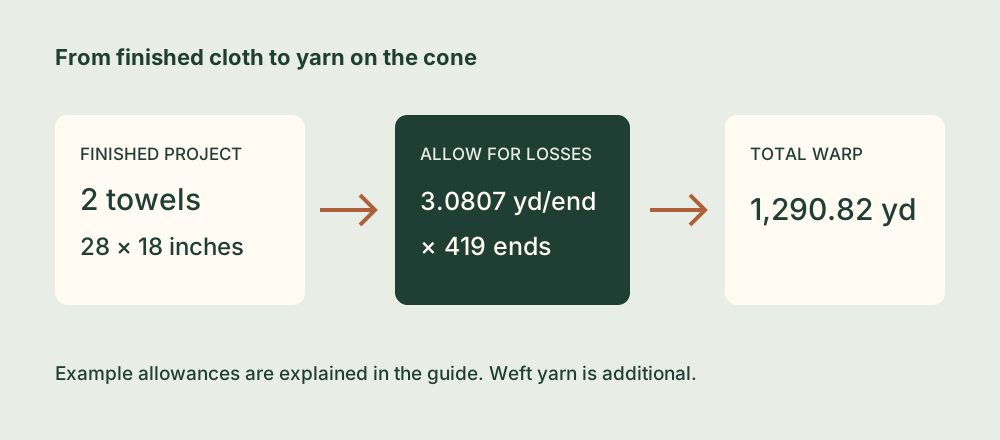
Length per end in yards = 110.9056 ÷ 36 = 3.0807 yd
Other worksheets may define take-up as a percentage added to the woven length. Those formulas produce a different answer. Use percentages measured in the same way as the calculator you choose. If a sample combines take-up and finishing loss into one measured percentage, avoid entering that entire loss separately in both fields.
A 10-inch sample that finishes at 9 inches has lost 10% of its original length. To finish at 10 inches, start with 10 ÷ 0.90 = 11.11 inches. Simply adding 10% would give 11 inches, which finishes at 9.9 inches under the same conditions.
3. Calculate width in reed and the number of ends
Work backward from the 18-inch finished width, allowing for width shrinkage and then draw-in. Multiply the result by the chosen EPI and round up to a whole thread before adding extra ends.
Width in reed = 19.5652 ÷ 0.94 = 20.8141 in
Base ends = round up (20.8141 × 20) = 417
Total ends = 417 + 2 floating selvedges = 419
Check the result against your draft. Pattern repeats, symmetry, reed threading, or the preferred treatment of the selvedges may require a different whole number of ends. If you change the end count, recalculate yarn before winding the warp. Confirm that the reed width fits your loom.
4. Calculate total warp yarn and color amounts
Multiply the full-precision length per end by the total ends. Round the amount you prepare upward to suit your measuring method and yarn supply.
Color A, 200 ends = 616.14 yd
Color B, 219 ends = 674.68 yd
This is warp yarn only. Your shopping total also needs weft yarn, plus any additional sampling or waste not already included. A cone's stated weight does not directly tell you yardage unless you know the yarn's yards per pound or meters per gram.
For metric work, use centimeters and ends per centimeter consistently, then divide total yarn centimeters by 100 to obtain meters. Do not enter an EPI value into a field expecting ends per centimeter.
5. Put the plan into WarpWise
Open WarpWise, choose inches, and enter the piece count, finished dimensions, sett, percentages, and allowances from the table. Add the floating selvedges and color end counts. Check that assigned color ends total 419; unassigned ends indicate threads that still need a color allocation.
Keep precision during calculation, then choose a practical length to measure on your warping board. Save or print the plan with the yarn, draft, and finishing method. After weaving, record the actual measurements so your next project uses evidence from your own loom.
Further reading: Schacht's Simple Math for Weavers explains the relationship between sett, width, and total ends. For calculator controls, see WarpWise support.